
Contents
Address certification using Melissa Data
Introduction
AddressMaster in Iptor IP1 provides the ability to have both interactive and batch Delivery Point Verification (DPV) of addresses via Melissa Data. The system will attempt to correct invalid addresses where applicable by proposing a modified address upon certification. It will also notify the user if any errors are encountered thus allowing the user to correct the errors.
Since the addresses will be standardized, the system will have the ability to notify if the same address has already been loaded into the file. This is the duplication control detection.
Address certification will provide a DPV for the United States only. Canadian address standardization is available but will not do DPV.
| Note | As per Canadian Law, not all addresses will be certified, only those address that are not registered with the government will be certified. |
Requirements
The following requirements must be met to run IP1 AddressMaster.
- You must have the AddressMaster library within your library list.
- You must be on IP1 release 7.3 or above.
- Your network must allow for access from the iSeries to the web with port 80 open.
Business rules setup
The following business rules have to be created/setup to operate AddressMaster. The purpose of this document is to assist Iptor IP1 consultants, setup appropriate business rules at a customer site for the specified process.
| Note | Setups will defer from one organisation to another, depending on the IP1 release version and the local controls/business rules in place. This document does not cover customised setup tasks of specific companies. Deviations from this setup should be covered by setup tasks written by individual companies. |
| Control file | Setup |
| BNADS/ADR-BNA Utilize BNA Address handling | 
This control file holds the licence key for Melissa Data. The entry of the licence key indicates address certification can occur using Melissa Data. On every address certification, the system will check for this key. If there is no licence key then the system will give an error message. |
| BNADS/ADR-CTL Address controls | 
This control file holds the following controls that are used on address validation.
|
| BNADS/ADR-ERR Prompt for the following errors | 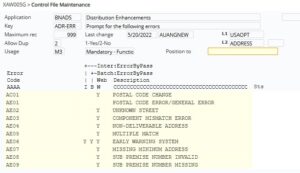
This is a system defined control file. By marking any of the individual errors with a “Y” will allow to by-pass checking of that error. WARNING: If any error is bypassed then you are unable to get DPV. The Error Code will display on the Address Standardization screen depending on the ErrorByPass indicator. |
| BNADS/ADR-PGM Address Program Control | 
This control file is partially system defined and it gets automatically updated as new programs interact with AddressMaster.
|
| BNADS/ADR-UA Users that can suppress addresses for all users | 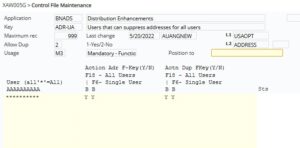 All the users that can suppress addresses are defined in this control file.
|
| TMSCRM/AV-CNTRY Address country code | 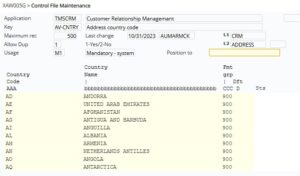
Maintain the format group for the country code in this control file. |
| TMSCRM/AV-DFN Address Validation / Search Definition | 
For the format group (Canada) enter the validation program ‘BNA010A’ in this control file and for USA ‘BNA010B’. |
| TMSCRM/AV-DFN2 Address Validation – bypass | 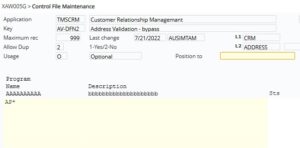
To bypass address validation for a program or a suite of programs update this control file. This will override control file BNADS/ADR-PGM. |
| TMSCRM/AV-DFN3 Address Validation 2 – Hard Error | 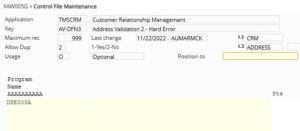
Maintain all programs in this control file that is to issue a hard error for invalid addresses. |
Melissa Data result codes
Pre IP1 V7.9
Pre IP1 V7.9 a version of Melissa Data was used which returned single character error codes. IP1 had a control record listing the error codes which it would recognise distinguishing between interactive processing and batch processing.
If address validation generated any of the selected error messages the generic BAD018 error would be returned. There was functionality to drill down and see the details.
IP1 V7.9+ with Melissa Data V2.0
On address validation Melissa Data would return result codes indicating the status of the validation, specifics of any errors or notifications etc. The latest version of Melissa Data has a list of 50 (4 character) result codes.
The result codes are in the following three groups.
- Prefix AS – status of the address
- Prefix AE – error codes
- Prefix AC – notification of changes Melissa Data made to the input address e.g. AC10 Changed the spelling of the street name
For a complete list of result codes from Melisssa Data address validation please see:
http://wiki.melissadata.com/index.php?title=Result_Code_Details#Address_Object
Message IDs have been added to the BNA010A message file, one for each result code where the message ID = result code with suffix 001.
The exception is AE10 ‘premise number invalid’ which has been split into two message IDs.
- This message could mean street and zip code are OK and the number is not valid
- It could also mean the street number does not match the zip code so any number will cause this result code.
- If the street/zip code combination is OK and the number is in a range for the plus 4, a plus 4 will be returned
- If plus 4 returned error AE10001 Premise number invalid
- Else error AE10002 Premise number invalid or street not found for zip code
The result codes to be processed need to be configured as required. It is suggested to enable more codes for the interactive to see what is returned and disable them later when you understand they are not required. For batch it is probably best to keep the equivalent of the current codes and review them later based on what you find for interactive.
It is possible to get the following response for a single address validation.
- AS01 valid address
- AS17 no mail delivery (Address does not receive mail at this time)
Online access to Melissa Data test
You can enter in addresses in Melissa Data directly to see what codes they return using http://www.melissadata.com/lookups/addressverify.asp
Address validation
It is your responsibility to ensure that you understand this procedure before performing the following tasks.
| Note | Deviations from this procedure should be covered by procedures written by your company. Before performing any tasks please ensure all the business rules are set-up accordingly. |
Validation on interactive processing
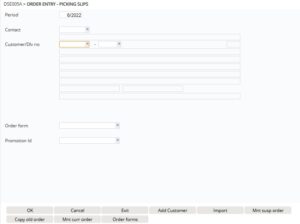
The calling program (DSE005 in the example below) must be set to prompt on error in interactive mode (BNADS/ADR-PGM), otherwise the system will not prompt regardless of address error. The address bypass must also not be flagged in control file TMSCRM/AV-DFN2.
When set to prompt on interactive mode, the system will prompt on either error on input address or if input address is changed by Melissa data and the control is set to prompt on change (BNADS/ADR-CTL). Specific errors can be set to bypass errors as well (see BNADS/ADR-ERR).
| Process | ||||||
| On interactive processing, the following address validation will occur.
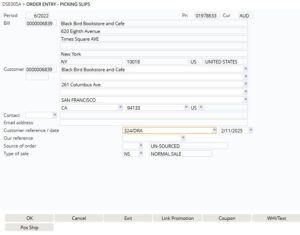
Example order processing:
On order header validation, AddressMaster will allow address verification using Melissa Data via the web. Only if there is an error on verification then the system will display the Address Standardization screen as shown below with the following information. At the top of the screen, it’s the input address that came into the address verification system. At the bottom of the screen, the output address is the modified address to US standards from Melissa Data.
|

Account duplication
On address verification, if an address already exits then Possible Account Duplication screen will display highlighting the duplicate address.

From the Possible Account Duplication screen, you can take actions using the following functions.
| Function | Description |
| F6=Stop prompt this addr | Will stop prompting this address for the current user |
| F7=Show/Suppress Detail | Will expand the line to show more details on the address. |
| F12=Cancel (Ignore Duplicate) | It will ignore the duplication. |
| F18=Stop prompting this addr for all Users | Will stop prompting this address for all users. |
Validation on batch processing
Batch validation is applicable for non-interactive processes like reports etc. An error report will print for any errors encountered during the batch validation.
Important note
- In an address there maybe, a need to have textual information, such as Attn: or other type. In most cases this can be identified and will not be processed as part of the address. However, at times the information provided is unclear and could get confused with the address, resulting in the alteration of the text information. To prevent this from occurring place a “.” at as the last character of the string for that line. This will identify to the system that this is text information only.
- Program BNADO210A is provided to assist in converting your system to use this. The program will place a “.” at the end of each line that does not have any numeric characters within it. Note this only applies to address lines 1 to 3. To run this program, please CALL BNADO210A from the command line.
- The system attempts to remember the last 10 addresses and the actions taken with those address for the current user session. For example, if you did a F12=Cancel on a duplicate prompt, the system will not prompt you for that address for some time. If you need to illustrate the duplicate address, signing off and on again will reset this.
